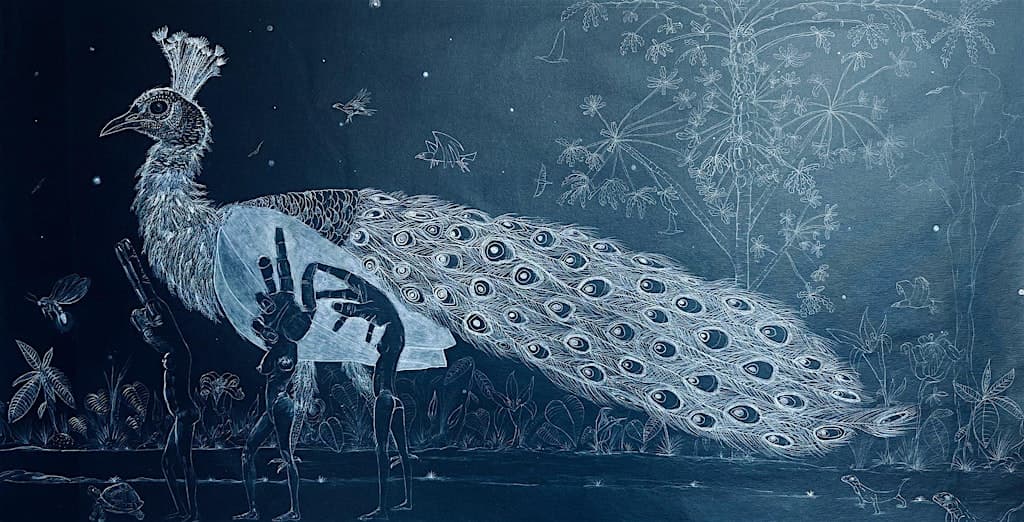
James Room, 4th Floor Barnard Hall
Queer Genealogies in Dominican Literature and Culture
Tue 10 Nov, 18:00 – 20:00
Free
About
Join us for an intergenerational conversation in celebration of Maja Horn's new book, Queer Genealogies in Dominican Literature and Culture. Join us for an intergenerational conversation in celebration of Maja Horn's Queer Genealogies in Dominican Literature and Culture (University Press of Florida, 2025), with Carlos U. Decena (Latino and Caribbean Studies, Rutgers University), Rosamond S. King (English, Brooklyn College) and Professor Horn’s former "Queer Caribbean Critique" seminar student, Mariley Melo, with Frances Negrón-Muntaner (English and Comparative Literature, Columbia) as moderator. In Queer Genealogies, Horn traces changing expressions of same-sex desire across Dominican literature, theater, and activism from the 1950s to the early 21st century. Drawing on over two decades of engagement with queer Dominican cultural networks, Horn maps a creole Dominican queerness and its coexistence and intersection with globalized forms of LGBTQ+ politics and identity expression. These multiple forms of queer expression are shaped by class, race, and gender, which produce both uneven access to public spaces and strategies for negotiating sexuality in more or less visible ways. Bringing together two senior scholars formative to Horn's thinking with former students now carrying this work forward, the conversation—accompanied by a slideshow drawn from Horn's personal archive of queer Dominican visual ephemera—will invite us to reflect on a central question: how do we teach and study gender and sexuality across generations and geographies, and what does a genealogical, rather than linear, approach to queerness make possible? Accessibility: This event is free and open to the public, and registration is required. ASL interpretation will be provided. A light reception will follow the conversation. Image credit: Ritual nocturno de amor, Noa Batlle, 2024 Maja Horn is professor in the Department of Spanish and Latin American Cultures at Barnard College. Beforehand she was a research associate at FLACSO (Facultad Latinoamericana de Ciencias Sociales) in Santo Domingo, Dominican Republic, where she developed and taught a performance studies concentration (2005-2006). Her research focuses on Hispanophone Caribbean cultures with an emphasis on literature, visual and performance art, gender and sexuality studies, and political culture. Her book, Masculinity after Trujillo: The Politics of Gender in Dominican Literature (Florida UP, 2014), foregrounds the impact of U.S. imperialism on dominant notions of Dominican masculinity and their reinterpretation by pivotal Dominican writers, including Hilma Contreras, Marcio Veloz Maggiolo, Rita Indiana Hernández, and Junot Díaz. She is the editor of a special dossier for Small Axe: A Caribbean Journal of Criticism dedicated to the memory of José E. Muñoz (2015) and of a special dossier on "Critical Currents in Dominican Gender and Sexuality Studies" (2018). Maja published her second monograph Queer Genealogies in Dominican Literature and Culture in 2025. She is currently developing a new research project tentatively titled, “Beyond Independence and Inclusion: Disability Narratives in the Americas, a Critical South-North Dialogue,” that asks what other normative goals and aspirations must be included alongside “independence/autonomy” and “inclusion/accessibility” in disability advocacy and studies? She explores this question through a critical and comparative analysis of disability narratives from both North and South America, with a particular focus on personal narratives from people with disabilities and/or their caretakers. Carlos Ulises Decena is an interdisciplinary scholar, whose work straddles the humanities and social sciences and whose intellectual projects engage and blur the boundaries among critical ethnic, queer and feminist studies and social justice. His first book, Tacit Subjects: Belonging and Same-Sex Desire among Dominican Immigrant Men, was published by Duke University Press in 2011. He is currently at work on two book-length projects: Body Portals: Embodiment in Early 21st Century Caribbean and Latinoamerican Artivism and Re-membered Country: Sexuality, Television, and Dominican Transnational Cultures. His work has appeared in the Journal of the National Medical Association, Social Text (a special issue titled “The Border Next Door which he coedited with Margaret Gray), Journal of Urban Health, Papeles de Población, AIDS Care and GLQ. He is also a co-editor of a Special Dossier on Latino Immigrants in New York State. Rosamond S. King: A critical and creative writer and artist, King’s book Island Bodies: Transgressive Sexualities in the Caribbean Imagination won the Caribbean Studies Association Best Book Prize (2015). Her scholarship has appeared in journals including The Journal of West Indian Literature and Women & Performance. King regularly presents at conferences around the world. Her poetry appears in the Lambda Literary Award-winning collection Rock | Salt | Stone, All the Rage, and dozens of journals and anthologies. She has performed at spaces such as Poets House, the African Performance Art Biennale, and the Encuentro Performance Festival. The Carol L. Zicklin Honors Academy Chair and a Professor of English at Brooklyn College, King is also the recipient of numerous fellowships, awards, and creative residencies, and teaches courses in Caribbean and African literature, creative writing, sexuality, performance, and immigrant literature. Mariley Melo is a Barnard College Class of 2026 alumna originally from the Dominican Republic. She double majored in Political Science and History, and minored in Women’s, Gender, and Sexuality Studies. Mariley took Professor Maja Horn’s Queer Caribbean Critique course in Fall 2025, bringing to the classroom her own experiences growing up queer in the Dominican Republic. The course provided an especially meaningful space for her to examine questions of queerness, identity, belonging, and the Caribbean from both personal and academic perspectives.
Location
Get directions